Bring a Better Question: The Case for Specificity in Startup Asks
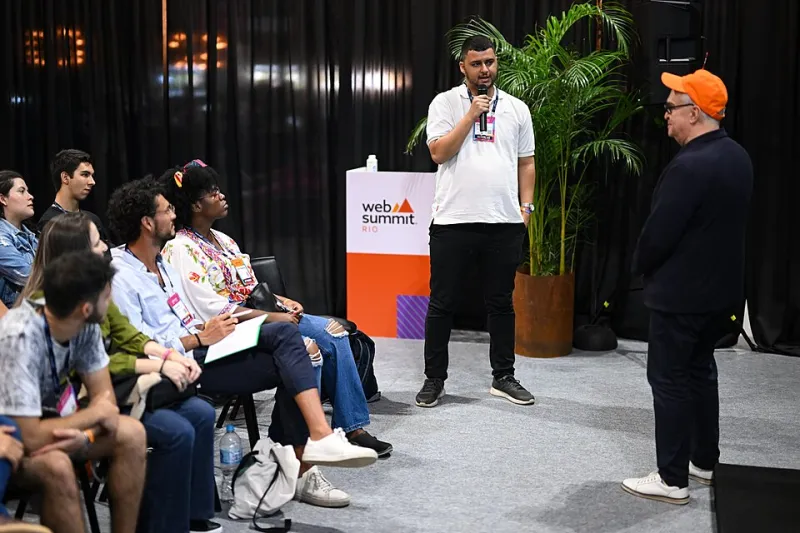
Photo: Web Summit Rio from Rio de Janeiro, Brazil, CC BY 2.0, via Wikimedia Commons
Founders are trained to ask for help. Investors, advisors, experienced operators—everyone says the same thing: reach out, ask questions, build your network. So why does so much of that outreach land like a thud?
Because 'Can I pick your brain?' is not a request. It's a blank check. The sender gets to feel like they've done something. The receiver gets to guess what they've signed up for. At ZYX Network, we hear both sides of this: founders who feel ignored and operators who feel buried under vague asks.
The fix is not to ask less. It's to ask better.
The hidden invoice behind a vague ask
A vague ask transfers work to the receiver. They have to figure out what you actually need, whether they can help, how long it will take, and what a useful answer looks like. That's cognitive load before the conversation even starts.
Think about the difference between a bug report that says 'it doesn't work' and one that includes steps to reproduce, expected behavior, and actual behavior. The second one is not more polite because it's longer. It's more polite because it respects the other person's time.
Busy people are not refusing to help. They're refusing to accept an undefined scope. If you can't explain the decision you're trying to make, the question you need answered, and the amount of time you're asking for, the receiver has no way to say yes without taking on risk.
Specificity is a form of respect
Specificity says: I've done my homework. I know why I'm asking you. I've narrowed the question enough that your answer can actually change what I do.
Compare these two messages. The first: 'Hi, I'm a founder in the fintech space and would love to pick your brain about fundraising.' The second: 'Hi, I'm deciding between a $1.5M seed at an $8M cap and a $2M round at a $10M cap. You raised a seed in 2024 and wrote about dilution. Could I ask three questions about how you thought about runway versus dilution? Fifteen minutes, async is fine.'
The second message is not magic. It just gives the receiver a way to evaluate the request. It also signals that you're not looking for a free consultant. You're looking for a specific perspective.
Reframe asks so busy people can say yes
Make the ask small enough to answer and clear enough to decline. Async-first is usually the right default. A short list of questions is easier to answer than a calendar link with no agenda.
If you want a conversation, say what you want to talk about and how long you need. If you want an intro, say who you want to meet and why. If you want feedback, share the artifact and the decision it supports. If you're not sure who can help, ask for a pointer rather than a meeting.
A useful template: 'I'm working on [decision]. I've tried [what you've tried]. I'm trying to learn [specific thing]. Would you be open to answering [one to three questions] over email? If not, no worries—can you point me to a resource or person who might know?'
That last line matters. It gives the receiver an easy out that still lets them be helpful. Busy people appreciate an exit ramp more than they appreciate flattery.
The graceful decline
If you're on the receiving end of a vague ask, you don't have to ignore it or say yes to a bottomless coffee meeting. You can teach specificity without being rude.
Try: 'Thanks for reaching out. I can't do a general brain-pick, but I'm happy to answer one specific question if you send it over. Here's a resource that might help in the meantime.'
If you're fully booked: 'I'm heads-down through [month], but [community or office hours] might be a better fit. If you send me the one decision you're stuck on, I can point you in a direction.'
That response is honest. It protects your time and leaves the door open. What it doesn't do is pretend that a vague request is a small one.
Build an ask protocol for your startup
If you're a founder, make asking a system, not a mood. Keep a simple doc with the decisions you're currently trying to make, the questions you need answered, and the people who might help. Before you send anything, run it through three checks: Is this specific? Is this the smallest useful ask? Am I giving the person an easy way to say no?
Track your asks the way you track product experiments. Who did you ask? What did you learn? Did you follow up with a thank-you and an update? Founders who close the loop get more help over time because people can see that their input mattered.
And give before you ask. Share a useful intro, a customer insight, a template, or a warning about a trap you've already hit. Generosity is not a debt transaction. It's a signal that you understand relationships are longer than your current raise.
The brain-pick that works
A good ask is a small, specific invitation to contribute. It tells the other person what you're working on, what you've already tried, and what kind of answer would actually help. It respects their calendar and their expertise. It makes saying yes easy and saying no safe.
That's not just better manners. In a startup, it's better information. Specific questions produce specific answers. Vague questions produce vague advice, if they produce anything at all. Bring a better question, and the right people will have a much easier time helping you.